

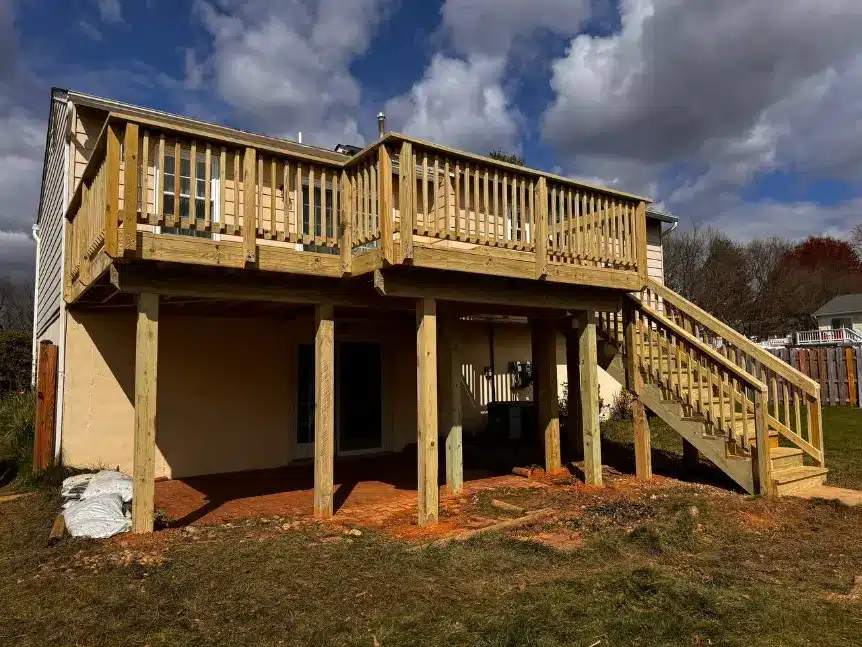
Every deck needs routine cleaning, a yearly check, and prompt attention when something looks wrong. Wood decks add a stain cycle that composite decks skip. You can usually save a worn finish for the next maintenance visit, but movement, soft wood, or a loose railing means calling a professional instead of waiting.
At TrueDecks®, we have spent more than 25 years building, cleaning, restoring, repairing, and resurfacing decks across Maryland, Virginia, and Washington, D.C., and the schedule below reflects what we see on those decks.
What Is a Good Deck Maintenance Schedule?
A good deck maintenance schedule spaces tasks based on how quickly each part of the deck wears. Dirt builds up all the time, finishes wear out over a few years, and framing problems develop slowly where you cannot see them. We use the schedule below as a starting point and adjust it for sun exposure, shade and tree cover, foot traffic, and the finish on the deck.
| Task | Wood Deck | Composite Deck |
| Sweep and clear debris from between boards | Regularly, more often under trees | Regularly, more often under trees |
| Walk-through of railings, stairs, fasteners, and soft spots | Once a year and after severe weather | Once a year and after severe weather |
| Professional cleaning | About once a year | About once a year |
| Stain recoat | Every 1 to 3 years, based on the stain | Not needed |
| Strip, sand, and recoat (restoration) | Only when the finish has failed | Not needed |
| Professional deck safety evaluation | Every 2 years as a routine multi-point inspection. Also as the deck ages, or when you notice movement, soft wood, or loose parts | Same as wood |
For the yearly walk-through, focus on the railings, stairs, fasteners, and soft spots listed in the table above. As a member of the North American Deck and Railing Association (NADRA), we also point homeowners to its free deck safety checklist for their own checks between visits.
How Often Does a Wood Deck Need a New Coat of Stain?
A wood deck needs a new coat of stain about every year with a transparent stain, every two years with a semi-transparent stain, and every three years with a solid stain. A quality deck stain also seals the wood, so this one recurring task covers both. The more wood grain a stain shows, the more often it needs a fresh coat. Before each deck staining visit, we check the existing finish to confirm where the deck sits in that cycle.
What Happens When a Deck Misses Its Maintenance Schedule?
When a deck misses its maintenance schedule, each skipped cycle makes the next visit more extensive and more expensive. In our experience, decks tend to follow this path:
- On schedule: a cleaning and a fresh coat of the same stain.
- One or two cycles missed: the finish wears through and the wood grays, so stripping and sanding come before staining.
- Several years unprotected: checking, cracking, and cupping lead to board repairs and replacement.
- Long-term neglect: moisture reaches the framing, and you have to decide between resurfacing and replacement.
Missed cycles and years without protection are where deck restoration comes in. Staying on schedule is the least expensive way to own a wood deck.
What Should You Do for Your Deck Each Season?
In Maryland, Virginia, and Washington, D.C., each season calls for a different deck task: inspect and book work in spring, clean and stain through summer and into fall, clear debris in fall, and check for storm and snow damage in winter.
- Spring: Do the yearly walk-through once winter is over, and book cleaning and staining early, since spring is the busiest season for outdoor work.
- Summer: This is the core of the staining window. Clean first, then stain when the wood is dry and the weather cooperates.
- Fall: Clear leaves before they mat down on the boards, and finish any staining while conditions still allow it.
- Winter: Check the deck after heavy snow or severe storms. If you notice movement or a loose railing, call for an evaluation instead of waiting for spring.
What Do Deck Warning Signs Mean?
Deck warning signs fall into two groups: finish wear, which can usually wait for the next scheduled visit, and structural warning signs, which should not wait. The table shows what the most common signs usually point to and what to do about each.
| Warning Sign | What It Usually Points To | Next Step |
| Water soaks in instead of beading | The finish has worn thin | Clean and recoat at the next visit |
| Faded color or gray wood showing | UV wear through the finish | Recoat, or strip and sand first if the wood has grayed widely |
| Mildew, algae, or dark staining | Organic buildup on the surface | Professional cleaning |
| Peeling or flaking finish | A failed coating | Restoration: strip, sand, and recoat |
| Raised nails or loose boards | Movement in boards and fasteners | Repair before the next coat goes on |
| Deep cracks, splits, or cupping | Long-term exposure | Board repair or replacement, since sanding cannot remove them |
| Soft or spongy wood | Possible rot | Professional evaluation |
| An unstable railing, sagging, or bouncing underfoot | A structural concern | Professional evaluation, without waiting for the next routine check |
| Rust on hardware or moisture stains near the house connection | Corrosion or water reaching the framing | Professional evaluation |
The last three rows matter most. Those problems often start where homeowners cannot see them: under the boards and at the connection to the house.
Does a Composite Deck Follow the Same Maintenance Schedule?
A composite deck follows a shorter maintenance schedule: it skips staining and restoration but keeps cleaning and framing checks. Leaving out the refinishing cycle is one reason we generally recommend composite decking for long-term performance.
Cleaning the boards depends on the product line. Trex, for example, provides different care and cleaning instructions for its early-generation boards and current lines, such as Transcend®, Enhance®, and Select®, and recommends a plastic shovel rather than a metal one for clearing snow.
Framing checks are easy to overlook on a composite deck. Most composite decks sit on pressure-treated joists, beams, and posts, and while quality boards often carry 25- to 50+-year manufacturer warranties, the wood underneath stays vulnerable to moisture. We include the framing in every inspection, and on the composite decks we build, we protect it from the start with framing sealant and joist protection tape.
Railings deserve the same attention. In our experience, composite railing systems have caused the most problems, mainly warping, and much of that traced back to poor installation by other contractors rather than the products themselves. Aluminum railings have needed the least attention, since they stay stable through temperature changes and their powder-coated finish holds up well.
When Does Restoration Beat Replacement for a Maintained Deck?
Restoration beats replacement when the framing is sound, and a deck that stays on its maintenance schedule is far more likely to be in that condition. Regular recoating keeps moisture out of the wood, and yearly checks catch loose or soft areas before they become bigger repairs.
Age isn’t the sole factor. We regularly evaluate older decks with years of service left in their framing, and we also find improperly built decks with moisture damage around ledgers, joists, and posts. How the deck was built, how well it sheds water, and how consistently it has been maintained tell us far more than its age.
Many homeowners also overlook a middle option: resurfacing. If the frame is sound or can be repaired, we keep it, strengthen what needs strengthening, bring safety details up to current code, protect the framing from moisture, and put new wood or composite boards and railings on top. When the framing itself has deteriorated, no stain or new surface will fix it, and replacement becomes the practical choice. A pressure-treated deck built and properly maintained today can typically last 15 to 20 years.
When Should You Call a Professional for Deck Maintenance?
Call a professional for anything structural, any cleaning beyond a garden hose, and before restoring or resurfacing an older deck. Homeowners can handle the routine parts of the schedule themselves: sweeping, clearing debris from between boards, cleaning up spills, and the yearly walk-through.
Bring in a professional when:
- The deck shows a structural warning sign from the table above. Our deck safety evaluation costs $300, and we credit the fee toward repairs if TrueDecks® performs them.
- The deck needs a deep cleaning. High-pressure washing can splinter wood and raise the grain, which is why we clean with our low-pressure PressureLess™ Cleaning & Preservation System.
- The finish has failed. Stripping, neutralizing, and sanding must come first because new stain cannot penetrate wood that still carries a failing coat.
- You are deciding whether to restore, resurface, or replace. The framing should be evaluated before any money goes into the surface.
When the deck needs professional work, our deck restoration packages range from routine cleaning and protection to complete restoration, including repairs, sanding, and refinishing.
Our crews work out of Gaithersburg and Columbia in Maryland and Brambleton in Virginia, covering homes across both states and Washington, D.C. Wherever your deck sits on this schedule, we can take a look and tell you what it needs next.